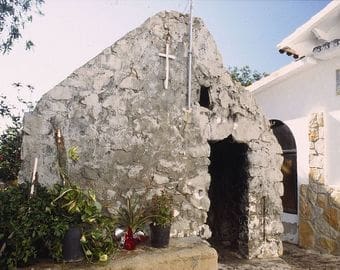

This hermitage is linked to the life and work of the venerable Fray Pedro Esteve. He was born in Dénia (1583-1658), in a house in Loreto street where there is a plaque that testifies it, to him is attributed the beginning of the festivities of the “Santísima Sang”. According to the story, in 1633 the neighbors of Dénia suffered from cholera. Fray Pedro Esteve took out, in procession, the image of the “Santísima Sang” and, after blessing some breads, he gave them to eat to the sick people and they, according to tradition, were healed. He is considered a religious man who has a lot of devotion in Dénia and in other towns of the region. Father Pere spent a lot of time dedicated to retreat, prayer and meditation, a tribute to this was the construction of the chapel that bears his name. There is a constant tradition among the people of Dianes, never denied, that Fray Pedro Esteve used the hut as a place of refuge for a time. The hut is a vaulted hut built of stone, so small that it is uncomfortable to access.
Some recent studies, carried out by local historians, attest that this construction was built as a cistern in order to collect rainwater from the Montgó torrents, in the seventeenth century. The most certain part of the tradition is that the Franciscan used this dwelling to protect himself from adverse weather conditions, since it is most likely that its construction was prior to the occupation by Fray Pedro Esteve.
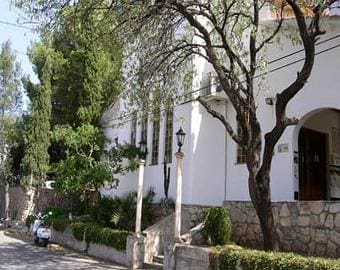
The construction of the hermitage was carried out in the XX century. Its interior houses scenes (in ceramic images) of the life and work of Fray Pedro Esteve.
Itinerary on foot:
We will start our walk from Diana street, placing us in the Parque Historiador Chabás, in the direction of the Montgó Natural Park. We will arrive at a crossroads where we will find a level crossing, we cross it and continue in front of us along the Camí de Sant Joan. We go round a traffic circle and take the second exit on our right, which is still Camí de Sant Joan. From this point, approximately 580 m., we will find a fork in the road where we see a central islet with a large carob tree, we can see an indication of the hermitage attached to the tree. We take the path on the right which is still the Camí de Sant Joan. Continue for about 600 m. until you reach a crossroads, take the path on your right called Camí del Assagador de Santa Llúcia. We will continue seeing the indication of the hermitage on a telephone pole. After about 300 m. we will find three paths, follow the one on the left, uphill, about 700 m. more and we can already see the sculpture dedicated to Pare Pere. We have arrived at the hermitage.
Another option is to start the route from the Plaza de Jaime I taking the Avda. del Montgó. After about 300 m. we reach a crossroads and we must continue along the road in front of us called Camí Pou de la Muntanya. We cross a level crossing, from here, we will not deviate from the route for 1 km. of travel. We will come to meet, straight ahead, with a telephone booth and a pharmacy indication, just at this point, there is a first detour to the right that we must pass and take the second, also to our right, which is called Carretera de la Colònia del Montgó. It is an uphill, heavily wooded and shaded by Mediterranean pine, which zigzags through the mountain to take us to the chapel. We will go about 800 m. to an islet, with a pine tree and a bike route sign, which we border leaving it to our left, we will go about 100 m. along the path that descends and we will have reached the hermitage. Once the visit is over, we can take the opportunity to walk the “Via Crucis” that ascends the Montgó and gives us spectacular views of Dénia and surroundings, as well as inviting us to enjoy nature.