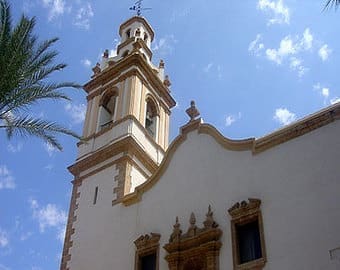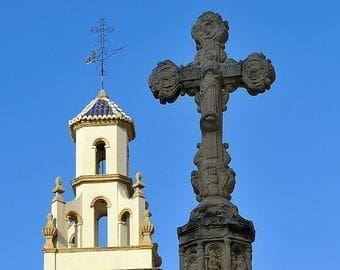

It corresponds to an architectural complex formed by the Convent of San Antonio de Padua, a Franciscan foundation of the sixteenth century, which was erected years later (first half of the seventeenth century) and the seventeenth century square. This complex suffered serious damage in the War of Succession, the French War and the Civil War.
The façade is Doric with a venerated niche containing a modern image of San Antonio de Padua. This church has a Latin cross plan, inscribed in a rectangle, with a nave and 8 side chapels. The elevation is arranged with Doric pilasters on pedestals. Inside, a large enameled cross with scenes from the Bible presides over the main altar, which was sculpted in 1990 by the German goldsmith Egino Weiner, an artist with several works exhibited in the Vatican Museum. The bell tower, to the left of the church, is part of the facade and from which the body of the bells stands out, showing Doric masonry pilasters with four semicircular arches.
In reference to the convent, it seems that it was built on what was the hermitage of the Mother of the Forsaken “Mare de Déu dels Desemparats”. Today, after the destruction during the Civil War, only a part of the cloister that surrounded the courtyard built with sandstone and masonry remains of the convent, as well as the exterior facade covered with ashlars, which given the greater resistance of these materials is what has been best preserved today. The remains of the cloister show the fronts of the 2 floors that formed it, calling special attention to the floor, at ground level, with 4 elegant semicircular arches framed by Tuscan pilasters. Attention is also paid to what remains of the entablature with a frieze, corbels and a projecting cornice, where elegant rectangular windows separated by pilasters appear above. The first floor had a groin vault. It seems that some fresco paintings decorated the lunettes of the cloister’s turns with passages from the life of St. Francis.