



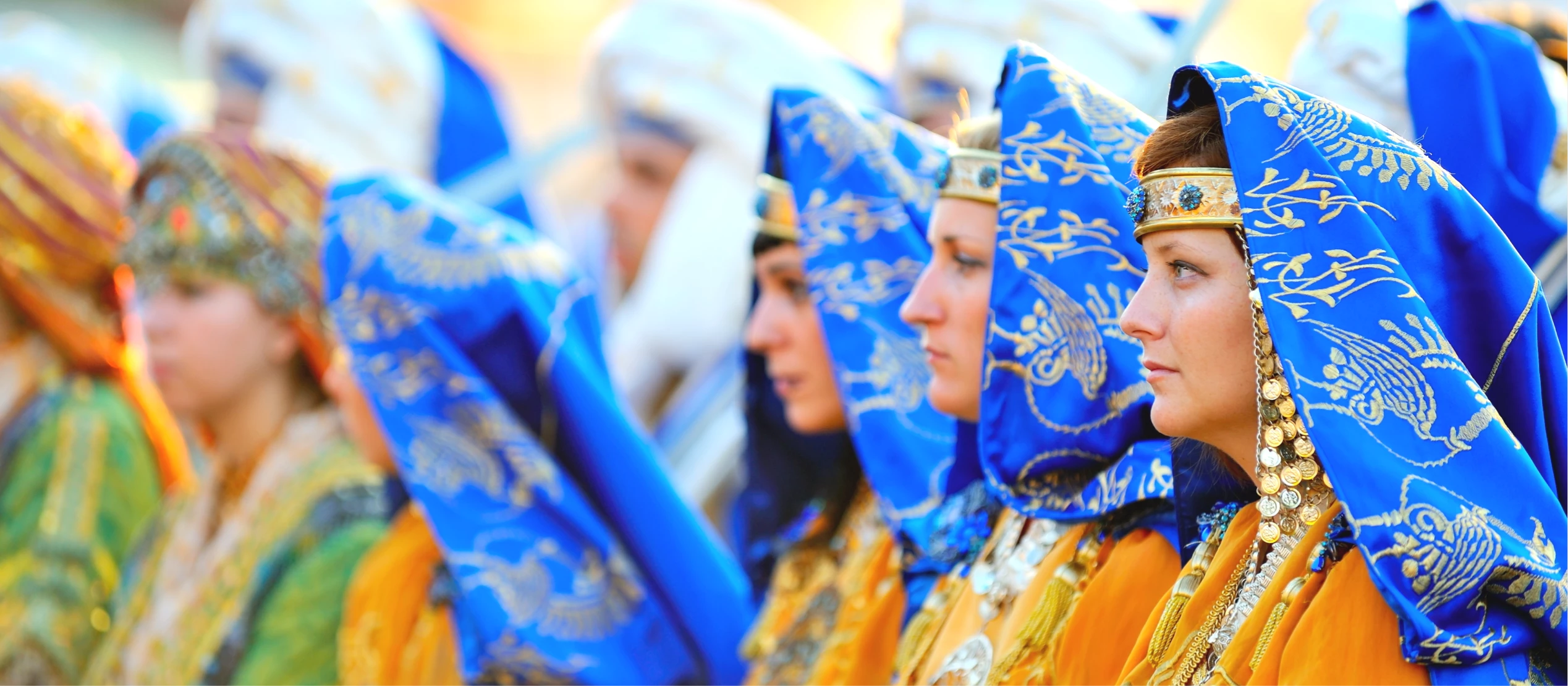
The Moors and Christians festivities of Dénia are a vibrant historical recreation that commemorates episodes of the Reconquest and are held in honor of San Roque. It has been declared a Festival of Tourist Interest in the Autonomous Community. This festivity is composed of a series of solemn and popular acts in which groups called “filaes” parade with elaborate costumes, festive armaments and choreographies, evoking the military and religious tradition. The event includes gunpowder displays such as dianas, retretas and embassies, small symbolic confrontations and the notable Entrada or Gran Desfile de Gala, where both the Moorish and Christian sides show off their best clothes in a colorful, musical and solemn parade that paralyzes the main streets of the city.
In Dénia, these festivities are accompanied by an exceptional community and family atmosphere: the festivity spans several days and includes presentations of charges, children’s parades, formal events and historical recreations on the beach with landings. It is a cultural event of great local significance, with music of pasodobles and Moorish and Christian marches that mark the rhythm of the events, generating emotions, pride and belonging among neighbors and visitors.
The Moors and Christians festivities of Dénia have their origin in the evocation of a historical Berber attack that took place in 1556, when galleots tried to disembark on the coast of Dénia and were repelled by the defenders of the city. The festival commemorates that event through a colorful display of parades, embassies and stagings that represent the arrival of the invaders -the “Moorish Entry”-, the signing of a truce and, finally, the Christian countermeasure. This historical recovery was enhanced in the 80s and 90s, when the filaes (groups) were consolidated, and took modern form in its festive format after the first official landing in 1981, strengthening citizen participation and the local festive fabric.
In its current format, the celebrations include a strong theatrical component: with dianas, embassies, parliaments, festive music and recreations with gunpowder and choreography. The central moment is the Grand Gala Parade, in which both sides – Moors and Christians – parade through the historic center with elaborate costumes and musical bands accompanying the route. The event combines religious, community and historical elements, generating a vibrant festive atmosphere that brings together neighbors and visitors around the history and identity of the town.
The opening day of the Moors and Christians of Dénia begins with the emotional proclamation, in which a figure selected by the Federation of Moors and Christians (FEMMICC), with a special bond with the city and the festival, publicly proclaims the beginning of the festivities. His voice resounds in squares and streets, officially marking the opening of a festive period full of light, gunpowder and tradition.
This speech serves as a symbolic bridge between local history and collective fervor, giving way to the coming days of parades, music and festive culture.
Then, the mayor of Dénia makes the symbolic delivery of the keys of the city to the president of the FEMMICC, representing the transfer of festive control to the festeros. This gesture ritualizes the passage of the city from the everyday to the festive, accompanied by the hoisting of flags in the Plaza del Consell. From that moment on, Dénia is officially immersed in a celebratory atmosphere, where every corner is dressed in festive clothes until culminating on August 16, the day of San Roque.
Filaes Moras
The Moorish side is inspired by the heritage of the taifa of Daniya, the Berber peoples and the medieval Islamic tradition that deeply marked the history of Dénia. Their costumes stand out for the intense colors, the presence of the crescent moon and references to the desert, the sea and the Arab culture.
Among their filaes we find:
Filaes Cristianas
The Christian side commemorates the arrival of Jaime I and the Christian repopulation after the reconquest. Its aesthetics is inspired by the medieval military orders, crusader knights and sailors defending the coast.
Among its filaes we find:
The staging of the Disembarkation of the Moors in Dénia is one of the most anticipated moments of the festival cycle. From the north breakwater, where the Moorish troops simulate a maritime invasion, they descend to the beach and are received by the Christians in an atmosphere of great expectation. Among cheers, festive music and thunder of arquebuses, the troops negotiate the truce in an emotional act that mixes theater, history and pure popular celebration.
This landing, which dates back to the first years of the modern festival -it is documented since 1981-, has become the symbolic starting point of the Moors and Christians of Dénia.
After the signing of the pact, the truce allows the festive coexistence between the two sides until the Christian landing, which closes the cycle with a battle of arquebusiers and the traditional “miracle of the fog”.
It is a visual and emotional spectacle that immerses the audience in a collective experience charged with tradition, theatricality and a sense of belonging.
The Grand Gala Parade is undoubtedly the most majestic and visual act of the Moors and Christians Festival of Dénia, a celebration that combines history, tradition and spectacularity. After the disembarkation and the first skirmish acts, the children’s parade opens the way to this great event that is not limited to being a simple parade: it is a real exhibition of festive power, where the Moorish and Christian filaes show their most sumptuous costumes to the beat of the festive marches while they walk along Marqués de Campo street.
Each comparsa, and especially the filà capitana, turns its passage into a show of pride and collective ingenuity: floats, choreography, banners, horses, camels, dancers, acrobats and standard bearers fill the route with color, music and theatricality, making the city stop to admire this unique representation. The parade symbolizes both the historical rivalry between Moors and Christians and the festive coexistence that characterizes Dénia today, offering locals and visitors an unforgettable experience, officially recognized as a Festival of Tourist Interest.
The Boato
At the heart of the gala parade is the pomp and pageantry, the great staging that accompanies the rank that holds the captaincy. It is a story told in movement, in which each year the Moorish and Christian captaincy build new narratives to convey their identity, their imaginary and their strength along the route.
The boato encompasses all the elements that surround the filà capitana: from the costumes and music to the floats, dance, cavalry and visual effects. Its preparation is the largest economic investment of the captaincy, as it depends largely on the collection made during the previous year and the creative and organizational capacity of each filà. Thus, each edition becomes an unrepeatable premiere that further enhances the parade.
The First Trò
Within the internal structure of each filà is the figure of the Primer Trò, the highest representative position and equivalent to the president in other festivals such as the Fallas. This position, which is usually rotating and with a duration of one festive year, involves the responsibility of coordinating the filà and represent its members in all events. The election of the Primer Trò is done through internal voting among the festeros, reinforcing the democratic, participatory and community character that defines these groups.
Dates: August 14 the children’s and August 15 the gala parade.
The battle of arquebusiers is one of the most intense and characteristic moments of the Moros i Cristians in Dénia. In this event, representatives of all the comparsas fire their arquebuses loaded with gunpowder in a great skirmish in the city center, traditionally in La Vía Street and Consell Square.
It is a festive display in which the rhythmic roar of gunfire creates an atmosphere of tension and collective emotion, symbolically marking the temporary triumph of one side and then the other. In addition, the legendary “miracle of the fog” is represented, when a mysterious mist rising from the sea facilitates the Christian conquest of the “castle”, awakening the historical and spiritual evocation of the festivity.
After the battle, the captains and members of the filaes parade in a ceremony of surrender, forming a symbolic corridor for the Moors to leave the city, and culminate with a retreta and final shot of blunderbusses that put an end to the acts.
It is a moment full of theatricality, gunpowder and community meaning, in which tradition, drama and spectacle come together to close a vibrant and festive day, reflecting the historical and festive spirit of Dénia.
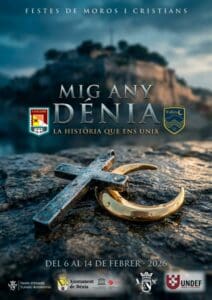
The celebration of Mig Any in Dénia marks an emotional milestone for the Moros y Cristians comparsas: it is the festive equator, the moment when the community recognizes that six months have passed since the main festivities in August and they have another six months to live them again. Although it is not linked to a specific historical tradition, this act arises from the shared desire to keep alive the festive passion and brotherhood within the filaes.
During Mig Any, participants wear their festive costumes, display the colors and symbols of their groups, and parade through the streets in an informal and cheerful atmosphere accompanied by band music. It is also the stage for the official presentation of the fila charges – as captains, standard-bearers and ambassadors – in an event that culminates with a dinner of brotherhood that combines reunion, shared history and projection of the future of the festival. The Mig Any is, therefore, a reaffirmation of the emotional commitment to tradition, a reunion that anticipates the biggest celebration and strengthens the ties between the protagonists and the festive community.
Date: Every year, at the end of February.
The festival of Sant Roc in Dénia, organized by the Brotherhood of Sant Roc since the early seventeenth century, mixes religious devotion and popular celebration in a program that fills the days of August with events for all audiences. In the devotional part, highlights the solemn mass in honor of the patron saint, followed by the traditional distribution of blessed bread and the procession where the image of Sant Roc walks the streets, living testimony of the faith and tradition of Denia.
But the festivities of Sant Roc go far beyond the liturgical. The “mayorales” -responsible for the organization- coordinate very deep-rooted participatory recreational activities, such as sports championships, gastronomic tastings in the street, popular celebrations and even the fireworks display that in some years closes the festive program. In this way, the festival offers a balance between spirituality, culture and fun, becoming a festive meeting point that adds to the celebration of the Moors and Christians and involves neighbors and visitors in a close and authentically local atmosphere.