
Around the Christian villas and immersed in the rural space, in the limits with forests, forests and some in areas then deserted, during the XIV and XV centuries – time of the Christian Conquest – hermitages are raised that present similar characteristics as far as their architecture. They are uninave buildings, with lateral chapels or not, covered with wooden framework and a double slope roof. Flat head with roof supported by pointed diaphragm arches. Its presence is confirmed throughout the Valencian area.
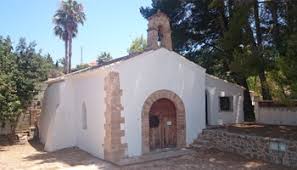
The hermitage of Santa Llúcia is a clear example of the hermitages of the “Conquest”, both for its location and its architectural features. This religious building dates from the fifteenth century with subsequent renovations between 1708-1812. It is a building with a single nave, rectangular in plan and its interior is elegantly divided into two sections by a central pointed arch formed by ashlars and voussoirs of rough stone, so characteristic in the construction of buildings of the time. Its structural reinforcement is reflected in the exterior buttresses joined to the walls built with the masonry technique. As for its main façade, the access portal formed by a semicircular arch with ashlars and voussoirs stands out. Crowning the facade we can observe a belfry of later chronology. The interior of the chapel is very remodeled and the image of Santa Llúcia is quite recent.
Of the oldest movable patrimony a chalice dated in the second half of the XVII century is conserved, that presents in its base an image of Santa Llúcia.
Itinerary on foot:
We will start our itinerary from the Tourist Office. We must head towards the port until we reach the traffic circle, at this point, we take the first direction to our right, we will be on the road from Dénia to Jávea (Las Rotas). We will continue along this road, without leaving it, until we reach another traffic circle which we go round and continue in the same direction, leaving the Real Club Náutico de Dénia on our left, and continue until we reach a third traffic circle where we will find a hotel in front of us. At this point, we take the road on the right called Camí d’Aranda. It takes us to a crossroads from where we must take the road to the left whose name is Camí Alt de Dénia-Xàbia, we go about 50m. and, on our right, we will recover the Camí d’Aranda. We will continue towards the Montgó without deviating from the road we are traveling, always uphill. We will reach the Camino de Santa Llúcia and we must continue along it, leaving the Sagrado Corazón school on our right (with its blue facade), until we find the Camí de L’Ermita de Santa Llúcia on our left. As a reference, look for a sign that leads to the Alfa y Omega School, take the road and find the Hermitage at the end of it. The environment of this hermitage is very pleasant, wooded and quiet. It invites the hiker to relax and let time pass, enjoying every moment of nature.