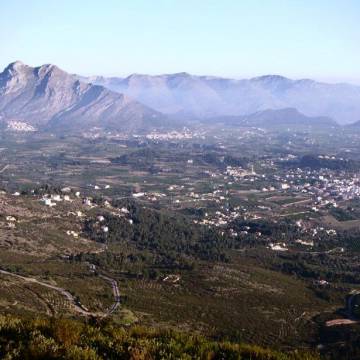
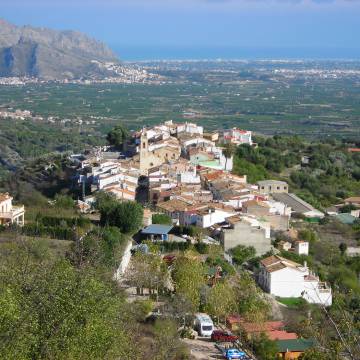
Vall de Pop, also known as Vall del Xaló, is a valley in the heart of the Marina Alta, made up of charming villages surrounded by mountains and vineyards. The route passes through towns such as Senija, Llíber, Xaló, Alcalalí, Parcent, Castell de Castells, Benigembla and Murla, each with its own heritage, traditions and landscapes. It is the perfect route for discovering rural life, wine culture and local cuisine.
We recommend visiting Tourist Info Vall de Pop to request further information about the area.
To head towards Vall de Pop, follow this route starting from Dénia:
PLACES OF INTEREST
SENIJA
- Its 18th-century church is built on the site of an old Arab mosque, of which significant remains are apparently hidden beneath the new structure.
LLÍBER
- In the centre of Llíber: the parish church of San Cosme and San Damián, in the neoclassical style. It is well worth taking a stroll around the church and the Calvary, as well as through the historic centre.
XALÓ
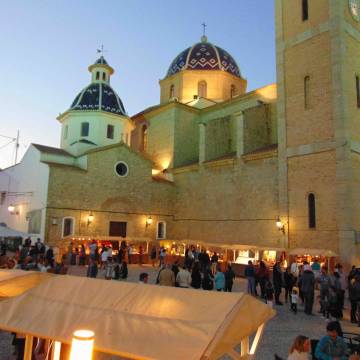
- In the centre of Jalón, you’ll find the Church of Santa María, built in the Neoclassical style, situated in the main square.
- Antiques Market. Every Saturday morning, the well-known Antiques Market takes place, where antiques are bought and sold and second-hand goods are on offer.
- Jalón and Alcalalí are two towns with a tradition of homemade cured meats and pastries.
Hiking. From here, you can access the Sierra de Bérnia.
ALCALALÍ
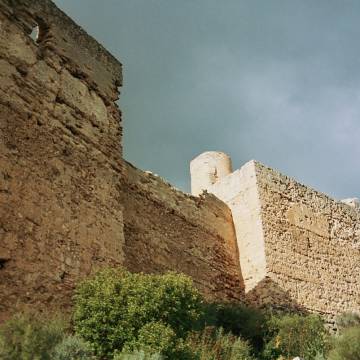
- A must-see is the Town Hall Square with the Parish Church of the Nativity of Our Lady. In the same square stands the town’s most iconic monument: the Medieval Tower (16th century), a magnificent viewpoint over the valley. You can also visit the Raisin Museum.
PARCENT
- The village of Parcent is surrounded by impressive mountains, with a special mention for the Coll de Rates mountain pass; if you climb to the summit, you’ll enjoy a wonderful view of the Vall de Pop and the neighbouring valleys.
- We’ll take a leisurely stroll through the town centre, visiting the Parish Church of the Immaculate Conception, and we’ll also visit the house where the writer Gabriel Miró lived.
- Typical dishes: Coques, paella, espencat, couscous, …
If we continue along the winding Coll de Rates road, just before reaching Tárbena, we’ll come across a turn-off to the right signposted ‘Castell de Castells’, the village where we’ll be making our next stop.
CASTELL DE CASTELLS
- Places to visit in Castell de Castells. The 17th-century Parish Church of Santa Ana is of great interest. The old town is also well worth a visit, as are the Ethnological Museum and the Museum of Macro-schematic
- Art or Rock Art, both housed in a manor house dating back over 200 years on Calle San Roque.
PLÀ DE PETRACOS
- From Castell de Castells, following the road towards Benigembla on the left-hand side, you will find the turn-off to the Sanctuary of Plà de Petracos, a site declared a World Heritage Site comprising highly abstract prehistoric paintings known as ‘macro-schematic art’ and one of the finest rock art sites in the Valencian Community.
- After visiting this beautiful site of incalculable historical value, we continue by car along the road and pass through Plà de Petracos, the area where the battle between the Moors and the Christians took place following the expulsion of the former in 1609.
- Once we have completed the Plà de Petracos route, we return to the road from Castell de Castells to Benigembla.
BENIGEMBLA
- We suggest a stroll through the historic centre, home to the late 18th–19th-century Neoclassical Parish Church of San José.
- It is well worth wandering around the town centre to see the traditional riuraus (traditional structures used, amongst other things, for drying raisins), the various fountains and several caves.
- We will then head to the town of Murla.
MURLA
- Its historical presence in the Vall de Pop was very significant throughout the Middle Ages and the Renaissance. In the 16th century, it was the only town in the inland area of the Marina Alta populated by Christians, who played an important role in repopulating the surrounding towns following the expulsion of the Moors in 1609.
- The monuments and buildings of interest include the Castle-Church of San Miguel, the Hermitage of La Sangre and the Hermitage of San Sebastián.