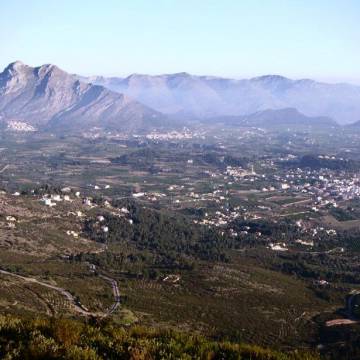
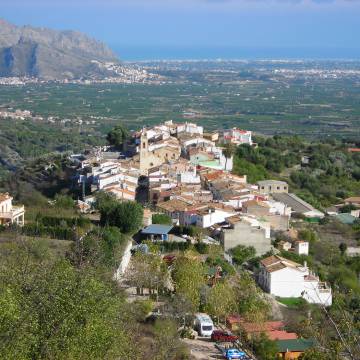
Venturing into Pego and the inland valleys means discovering another side of the Marina Alta, where the landscape changes completely. Surrounded by mountains, farmland and charming little villages, this route showcases the authenticity of the inland region: living traditions, local cuisine and a natural environment of great beauty, just a few kilometres from the Marjal de Pego-Oliva Natural Park.
PLACES OF INTEREST
Marjal de Pego-Oliva Natural Park, inland villages, local cuisine, agricultural and mountain landscapes.
- Explore the inland region, where the landscape and customs change. To reach Pego, take the N-332 (towards Valencia) from Dénia towards the junction with the CV-700, skirting the Marjal de Pego-Oliva Natural Park.
- Wear comfortable clothing and footwear suitable for walking.
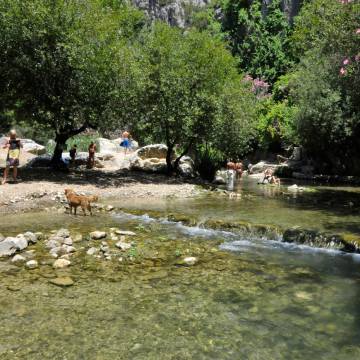
- The Pego-Oliva Marsh Natural Park is a 1,290-hectare wetland protected and fed by the Bullent and Racons rivers. It is home to a wealth of biodiversity (such as the samaruc fish) which coexists with traditional rice cultivation.
PEGO
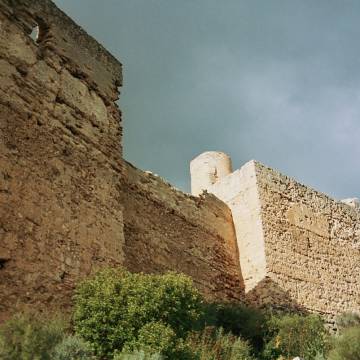
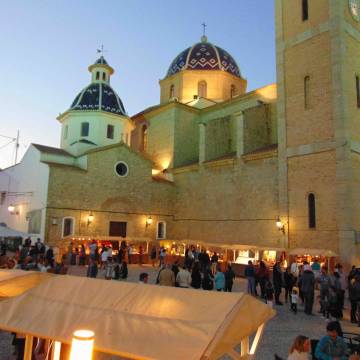
- In Pego, we will explore its medieval old town, visiting the Chapel of the Ecce Homo, the Church of the Assumption and the Cultural Centre, which houses museums and remains of the 13th-century city walls. Other highlights include the Portal de Sala and Ambra Castle (12th–13th centuries), the town’s former refuge.
- To get from Pego to Atzúbia, take the CV-700; the distance is just 3.5 km.
ATZÚBIA
- Atzúbia is notable for its Muslim old town and the Moorish Fountain. To reach Forna, cross the quarry until you can see its feudal castle (12th–13th centuries), one of the best-preserved in Alicante. It was the ancestral home of the Cruïlles family.
- To visit it, park and walk for 5 minutes along the path to the fortress. Check opening times at the Town Hall or the tourist office in Pego i les Valls.
FORNA
- Just 2 km from Atzúbia lies Forna, a village of white, steep streets with spectacular views. Its traditional cuisine offers dishes such as blat picat, coques escaldades with stew, minchos with garlic and olive oil, rabbit with garlic, wild boar, paella with meatballs and the iconic arroz con costra.
- To finish, its famous seasonal cherries are a highlight, which can even be enjoyed soaked in homemade liqueur in the local restaurants.
From Forna to Vall de Gallinera
We head back to the main road and reach the junction with the CV-700, which leads to Vall de Gallinera, comprising eight villages: Benirrama, Benialí, Benitaia, Benissivà, La Carroja, Alpatró, Llombai and Benissili.
VALL DE GALLINERA
- Each village has an old town with narrow streets and flower-bedecked doorways, where the churches, fountains and traditional wash houses stand out. Along the way, the mountains on the left reveal the Sierra Foradada, so named because of the large hole that pierces its summit.
- The area is home to the castles of Benirrama and Benissili, both difficult to access, which protected the valley’s entrances via Pego and Planes respectively. Other highlights in the Vall de Gallinera include the Alpatró Ethnological Museum and the Montaña de Alicante cherry cooperative.
VALL D’ALCALÀ
Following the road towards the Vall d’Alcalà, after passing Alcalá de la Jovada, a track on the left leads to the ruins of L’Atzubieta, a Moorish settlement abandoned in 1609. A few metres away is the Nevera de Baix, where snow was once stored in layers of straw to be turned into blocks of ice that were sold in Dénia for preserving fish.
From La Vall d’Alcalà to La Vall d’Ebo
Heading towards La Vall d’Ebo, 8 km along the road you will come to the Cueva del Rull, which is open all year round with continuous opening hours (it does not close at midday). Tickets can be purchased at the entrance to the cave. This small cave features a large number of stalactites and stalagmites, as well as various formations resembling animals, etc.
LA VALL D’EBO
- Crossing the bridge towards La Vall d’Ebo, you’ll find the Ethnological Museum, which showcases traditional local life, and you can sample ronyoses, traditional almond sweets. For the return journey, head to Pego (12 km away), where the walls of Ambra Castle offer spectacular views of the Marjal Natural Park and the coastline stretching as far as Montgó, before returning to Dénia.